





Ousha Al Suwaidi Life, Poetry, Achievements and Legacy of the Emirati Poet
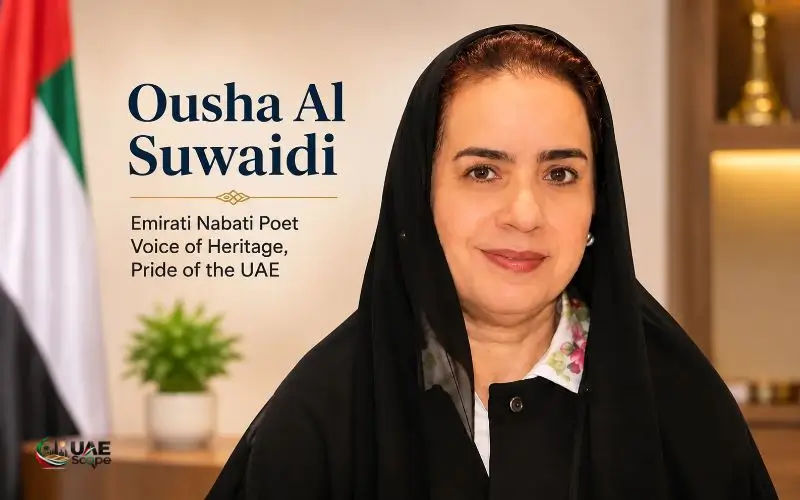
Ousha Al Suwaidi is known as a famous Emirati poet who was recognized for composing Arabic poetry. One of her nicknames was also Fatat Al Arab (Girl of the Arabs). Her poems were on love, life, wisdom, patriotism and Emirati traditions. She was one of the most highly respected UAE female poets. Ousha bint Khalifa Al Suwaidi was born in Al Ain in 1920. Her family was a poetry- and literature-loving family. She began to get her work published in poetry when she was 15 years old. Poets were predominantly male at that time, but she had carved out her own niche through her talent and work.
Today, Ousha Al Suwaidi is remembered for her poetry and her contribution to Emirati culture. Her efforts helped preserve traditional Arabic poetry and encouraged many women to become interested in writing and literature.
Quick Facts About Ousha Al Suwaidi
Here are some important details about her life and literary career:
- Name: Ousha bint Khalifa Al Suwaidi
- Nicknames: Ousha Al Suwaidi and Ousha the Poet.
- Popular title: Fatat Al Arab (Girl of the Arabs)
- Nickname in the past: Fatat Al Khaleej (Girl of the Gulf)
- Born January 1, 1920
- Al Ain, United Arab Emirates, is where he was born.
- Profession: Emirati poet
- Poems are in the Nabati style:
- Main language: Arabic
- Significant work: Traditional poetry, cultural expression and literary influence.
- Year of death: 2018
- The child’s age at the time of death: 98 years
The Ousha Al Suwaidi Foundation documents her life and achievements and UAE cultural institutions recognize her.
Early Life and Family Background
Ousha bint Khalifa Al Suwaidi was born in the historic city of Al Ain in the Emirate of Abu Dhabi on January 1, 1920. Her family valued literature and poetry, and traditional Arabic expression.
Her love of poetry originated in her childhood. She was able to meet poets, hear their recitations and learn about traditional Arabic literary forms.
Her childhood growing up around poetry helped her to develop a good sense of language, rhythm and expression. She did not read poetry only as an occasional hobby; she was actually involved in poetry as an important aspect of her life.
Her Childhood Interest in Poetry
Since childhood, Ousha had a passion for poetry. She was inspired by the work of well-known poets and created her own poetic voice by reading, observing and writing.
The following factors were important in her early life:
- Literary-minded members of the family.
- Traditional Arab poetry and storytelling.
- Poets she visited or knew in her cultural world.
- Oral music of Nabati poetry.
- The history and everyday experiences of life in the Arabian Peninsula.
Her early poetry experiences made her develop a unique voice which went on to gain national attention.
How Ousha Al Suwaidi Became Famous
Ousha Al Suwaidi became popular in her teens. When she was 15, her poetry recitals were gaining attention in the poetry community.
It was especially remarkable since women were not noticeable in the literary world at the time. She built a strong reputation through her confidence, poetic skill, and mastery of traditional expression.
She went on to write and recite poetry, slowly establishing herself as one of the most famous female voices in Emirati literature.
Her Recognition at a Young Age
Her early recognition was a result of several attributes:
- Excellent expression in Arabic.
- A gift for poetically expressing feelings.
- Knowledge of traditional forms of Nabati.
- Confidence in public recitations of poetry.
- A unique literary style.
Her success also helped to dispel the notion that traditional poetry was a domain for men. She was an inspiration to the young women who wished to engage in literature and cultural pursuits.
Why Was Ousha Al Suwaidi Called Fatat Al Arab?
Fatat Al Arab, or Girl of the Arabs, is one of the most popular names that is associated with Ousha Al Suwaidi.
The title became attached to her and associated with her literary identity and her impact on Arabic poetry. Sheikh Mohammed bin Rashid Al Maktoum was also a great contributor to popularizing this title by recognizing her work.
She was, too, Fatat Al Khaleej (Girl of the Gulf) as she was prominent in the cultural and literary activities of the region.
These titles are more than a simple recognition. They are a tribute to the respect she had accrued from years of writing, reciting and contributing to traditional poetry.
Understanding Ousha Al Suwaidi’s Nabati Poetry
Nabati poetry is an old style of Arabic rhymes that appeared in the Arabian Peninsula. It is closely linked to the Bedouin tradition, cultural practices, oral history and local language of the region.
In Nabati poetry, the use of regional vocabulary and expressions is common, unlike in formal classical Arabic poetry. It enables poets to explore the personal, emotional and social values, and the ordinary life of the people, using a language that they understand.
Ousha Al Suwaidi was among the most esteemed poets in this tradition.
Main Themes in Her Poetry
Her poems covered a number of topics relating to human feelings and Emirati culture.
Important themes included:
- Love: Personal feelings, relationships and emotional experiences.
- Wisdom: Observations and insights on life, behavior and personal experience.
- Patriotism: Love towards the UAE, its people and cultural identity.
- Nostalgia: Longing for the past and the old-fashioned lifestyles.
- Nature: The Arabian Gulf, desert landscapes and the natural environment.
- Heritage: local customs, social traditions and history of the region.
These themes have allowed her to make her poetry resonate with different generations of readers and listeners.
The Influence of the Arabian Desert and Gulf
Her writing was inspired by the Arabian desert and Gulf climate. Her poems captured the places, memories and experiences of living in the area. She applied the common images and expressions of her culture to convey ideas significant to Emirati society.
Her poetry helped to preserve aspects of traditional life at a period of great social and economic transformation in the UAE.
Poets Who Influenced Her Writing
Ousha Al Suwaidi acquired her knowledge of literature from reading classical Arabic poets as well as the well-known Nabati poets from the Arabian Peninsula.
She wanted to be inspired by the following people:
- Al Mutanabbi: One of the greatest classical Arabic poets.
- Abu Tammam: One of the great poets of classical Arabic literature.
- Al Ma’arri: A well-known poet and scholar of philosophy.
- Al Majdi bin Thahir—a well-known Nabati poet.
- A traditional poet of the area, Rashid Al Khalawi.
- In her biography, it is stated that Saleem bin Abdul Hai was one of the local inspirations for her poetry.
- Mohsin Hazzani: Another poet who influenced her poetry.
Learning about various poetic traditions gave Ousha a solid grounding in Arabic literature, and also helped her find her own poetic voice.
Ousha Al Suwaidi’s Literary Work and Publications
Ousha Al Suwaidi wrote a vast amount of poetry. She wrote for newspapers, magazines, audio recordings and published poetry books.
She wrote her poems in print and her voice was their voice. She was also accompanied by many famous Emirati and Arab singers to present her poetry to others, not just those in literary circles.
Her First Poetry Collection
One of the important milestones in her literary career was the publication of her poetry collection in 1990.
The first collection was published by the poet Hamad bin Khalifa Bu Shehab. In 2000, a second edition was published.
The publication of these works kept her poems in writing and accessible to readers, researchers and future generations.
Her Official Biography
Dr. Rafia Ghubash published in 2011 an official biography on Ousha bint Khalifa Al Suwaidi, Fatat Al Arab.
The book chronicled her life, literary growth and her impact on Emirati culture.
For those interested in her background and contribution to traditional Arabic poetry, her biography is a valuable resource.
Major Awards and Achievements
Ousha Al Suwaidi was honoured by cultural organisations and institutions in the UAE for her service to literature.
Her work was indicative of the significance of traditional poetry and the rise of the literary voice of women.
She has won several prestigious awards, such as:
1. Abu Dhabi Award
Ousha Al Suwaidi was honored with the Abu Dhabi Award for her support of Emirati culture and literature.
This honour was a recognition of the value of her poetry in maintaining local vocabulary, identity and cultural expression.
2. Sharjah Festival of Classic Poetry
She was honored at the 11th Sharjah Festival of Classic Poetry in 2010. It was a tribute to her literary contribution and the respect she garnered among the Arabic poetry community.
3. Al Owais Award
In 2012, Ousha Al Suwaidi was honored with the Al Owais cultural awards in the field of popular culture and Nabati poetry. The recognition acknowledged that she had a long-standing impact on Emirati literature.
4. Abu Dhabi Festival Award
She was posthumously awarded the Abu Dhabi Festival Award by the Abu Dhabi Music and Arts Foundation in 2019. The prize highlighted her unparalleled literary contributions and the role she played in humanizing Arab culture.
5. Abu Dhabi International Book Fair Recognition
She was also recognized as the Focused Personality of the Year at the Abu Dhabi International Book Fair in 2019. A special part of the event recognized her contribution and legacy in literature.
Ousha Al Suwaidi’s Contribution to Women in Emirati Literature
An achievement of hers was contributing to the recognition of women in traditional poetry. When she was a young woman, there were very few women in the public literary scene. Her achievements proved that women had the capacity to be influential voices in Nabati poetry too.
She was more than just a poet; she was an influence. She contributed to promoting the recognition of more Emirati women poets, as well as bringing women into the cultural history of the nation.
Her Influence on Future Generations
She has been remembered in cultural programmes, through literary awards and younger poets.
It is important to highlight several aspects that explain her contribution:
- She built up a niche for herself in the field of traditional Arabic poetry.
- She raised the profile of women poets.
- She promoted the appreciation of the Emirati language and culture.
- She was a role model for other writers.
- Her work helped preserve traditional cultural expression.
In 2011, the annual Emirati Poet Award for women was inaugurated in her name to honor the contributions women make to literature.
Cultural Recognition and Memorials in Her Honour
Ousha Al Suwaidi’s impact goes beyond awards and publications. Her name and literary works have been kept alive by various cultural programs.
Women’s Museum in Dubai
One of the Dubai Women’s Museum’s exhibits is dedicated to Ousha Al Suwaidi.
She was honoured for her work and contribution to the history of women in the UAE. It further enables visitors to appreciate the significance of women writers in Emirati culture.
Library at Emirates International School
Emirates International School also had a Library named after her.
It serves as a tribute to her as a writer, and helps to link her legacy with education.
Annual Award for Female Emirati Poets
In 2011, she was honored by the establishment of an annual award for female Emirati poets in her name. The award continues the thought that women should be given opportunities to learn how to write and be recognized for their writing.
These are steps in making her contribution known in the cultural and educational landscape of the UAE.
Google Doodle Honouring Ousha Al Suwaidi
Google, on November 28, 2022, celebrated Ousha Al Suwaidi with a special Google Doodle. The art depicted her role in the poetry of the Nabati people and her impact on female poets in the Arab world.
It was made by Emirati artist Reem Al Mazrouei of the UAE, based in Abu Dhabi. It brought her story to the international world at large and made her a significant part of the UAE’s cultural heritage.
It was also important because it coincided with the day of last year’s recognition of her literary contribution, which marked the beginning of an annual award for female Emirati poets.
The Google Doodle highlighted several things about her life:
- Early success as a poet.
- Her work in the field of Nabati literature.
- Her impact on women authors.
- Her association with Emirati culture.
- Her enduring legacy in the literary world of the Arab people.
- The recognition demonstrates that her work is still relevant beyond the UAE.
Ousha Al Suwaidi’s Final Years and Death
Ousha Al Suwaidi has lived in Al Ain for most of her life, apart from about 15 years in Qatar. She moved to Dubai in the late 1980s. Throughout her life, she grew to be a celebrated cultural icon whose poetry was enjoyed by readers, writers and public speakers.
In July 2018, she died at the age of 98. She was mourned by many in the UAE, with her impact on the country’s literature and culture being celebrated at her death. The Emirates Writers Union termed her a “legendary Emirati poet” and named her one of the founders of the movement of women’s poetry in the UAE as well as the movement of Nabati poetry as a whole.
Why Ousha Al Suwaidi Remains Important Today
Ousha Al Suwaidi’s impact is still remarkable, as her achievement transcended mere literary success. She played a significant part in sustaining a traditional means of Arabic expression and promoted the importance of women in the cultural life of the UAE.
Her poems offer a glimpse into the feelings, past, values and landscapes of Emirati society.
These are the enduring legacies of her importance:
- Maintenance of Nabati poetry: Her work helped to sustain interest in a traditional form of literature.
- Fostering Emirati spirit: Her poetry was a reflection of the local culture, language and heritage.
- Encouraging future generations of female poets with their success: Her success inspired future generations of female poets.
- Inspiring cultural research: Her life and work remain subjects of literary interest.
- Her poems are read, recited and performed, connecting generations.
Her legacy was that she was an important medium through which the identity and history of a nation were kept alive.
Conclusion
Ousha Al Suwaidi was a remarkable Emirati poet whose poetry made an impact on Nabati poetry and Arab culture. She was born in Al Ain in 1920 and was already famous when she was still young and was widely known as Fatat Al Arab. Her poems were about love, wisdom, patriotism, nostalgia and traditions of the Arabian Peninsula.
Her writing enabled her to contribute to the preservation of Emirati heritage and increased awareness of women in traditional poetry. Her awards, publications, cultural memorials, and annual poetry award, established in her name, continue to honor her contribution.
Ousha Al Suwaidi passed away in 2018 but is still a significant figure in the history of UAE literature. She is still inspiring readers, poets and those interested in the country’s culture and traditions.
Read Also: Dr. Saniya Habboub
Frequently Asked Questions
Who was Ousha Al Suwaidi?
Ousha Al Suwaidi was an eminent female Emirati poet who had contributed to the field of Nabati poetry. Ousha bint Khalifa Al Suwaidi was her full name, which could be used as a stage name, and she was one of the most popular female poets of the 20th century.
Why was Ousha Al Suwaidi called Fatat Al Arab?
She was also called Fatat Al Arab, or Girl of the Arabs. Her literary name and reputation were inextricably linked to the title.
When and where was Ousha Al Suwaidi born?
Ousha Al Suwaidi was born in Al Ain, United Arab Emirates, in the Emirate of Abu Dhabi on January 1, 1920.
What type of poetry did Ousha Al Suwaidi write?
Her most well-known work was in the form of Arabic poetry, known as Nabati, which is typical of the Arabian Peninsula. Her poems were on matters of love, wisdom, patriotism, nostalgia and Emirati heritage.
What awards did Ousha Al Suwaidi receive?
She was the winner of the Abu Dhabi Award, the Sharjah Festival of Classic Poetry awards, the Al Owais Award, and the Abu Dhabi Festival Award. She is also the 2019 Focused Personality of the Year at the 2019 Abu Dhabi International Book Fair.
When did Ousha Al Suwaidi die?
Ousha Al Suwaidi was 98 when she died in July 2018. Her literary work remains honored in a number of publications, cultural events and awards bearing her name.